Rue des Teinturiers and the hidden streets of Avignon
Most visitors do the Palace, the Bridge, the Rocher des Doms — and leave. There is another Avignon: the medieval alleys, the flower-filled inner courtyards, and the Teinturiers canal with its watermill wheels still turning.
There is the Avignon of guidebooks — Palace of the Popes, Saint-Bénézet Bridge, the Halles market — and there is the Avignon of those who slow down. The second city is smaller, quieter, and infinitely more addictive. Since we started renting apartments inside the city walls, we have spent considerable time guiding our guests toward this less-photographed version.
The rue des Teinturiers is its heart.
Rue des Teinturiers: the story of cloth in a single street
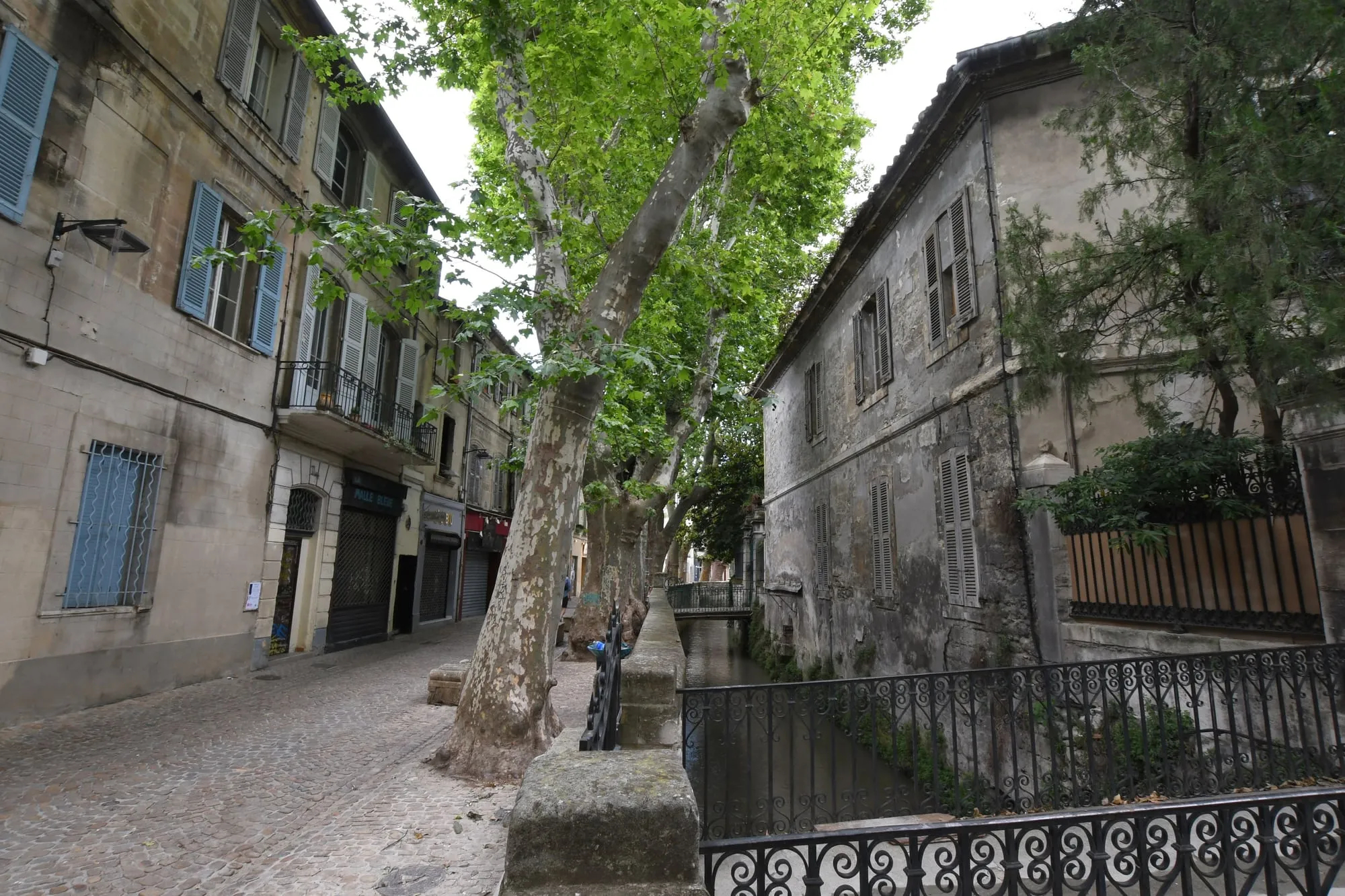
Le quartier des Teinturiers incarne l’âme authentique d’Avignon avec ses ruelles pavées bordant la Sorgue, ses roues à aubes historiques et ses platanes centenaires. Cette enclave préservée, à deux pas du Palais des Papes, révèle un Avignon intime et vivant, loin de l’agitation touristique du centre.
A forgotten industry along a canal
In the 18th century, Avignon was a textile power. The Teinturiers quarter (teinturiers means dyers) employed hundreds of craftspeople who dyed fabrics — silk, wool, cotton — in the waters of the Sorgue diverted from L’Isle. The canal powered mill wheels that drove fulling machines and looms.
Today, that canal still flows. Four watermill wheels turn still, steadily, driven by nothing but the current. They no longer power anything — they turn for the sake of turning, and because someone thought to list them as historic monuments before anyone considered stopping them.
What you see walking the street
The street is 400 metres long. You walk it in 20 minutes if you stop at each detail.
The plane trees first: centuries old, they form a canopy that turns the street into a green tunnel in summer. Even in full July heat, you walk in shade. The light filters through in dappled patches onto the cobblestones — one of the most photographable light effects in Avignon.
The mill wheels: the first is visible from the street itself, set into the stone wall on the right after the small bridge. The second, more imposing, stands at the level of the Chapelle des Pénitents Gris. Approach the parapet and look down — the wheel turns in the dark current with a hypnotic slowness.
The facades: craftsmen’s workshops (ceramicist, luthier, photographer), independent galleries, small restaurants with canal-side terraces. It is not “picturesque” in the postcard sense — it is lived-in, with bicycles at the door and cats on the windowsills.
The surrounding quarter: secret courtyards
The rue des Teinturiers is the thread, but the neighbourhood around it is equally worth exploring. Here you find what Avignon has in rarest supply: accessible inner courtyards.
Rue Velouterie and rue des Fourbisseurs
Parallel to the Teinturiers, these two streets preserve an almost intact 18th-century architecture. The buildings are tall (4-5 floors), and open carriage doors reveal cobbled courtyards with fountains. I counted seven of them on a single walk — and six had plants spilling from the balconies.
What to look for: marble plaques set into the walls marking the historic flood levels of the Sorgue. The highest flood mark dates from 1755. Look at knee height on facades near the canal.
Impasse du Portail-Peint
From rue des Teinturiers, take the first alley on the right after the chapel. It ends at a trompe-l’oeil painted portal from the 18th century — an illusion of depth on a blank wall. Nobody goes there. It is your private discovery.
The courtyard of the former Jesuit College (rue Banasterie)
Near the Teinturiers, rue Banasterie holds the entrance to a former Jesuit college whose courtyard is sometimes open in the mornings. If the carriage door is ajar, step in. The courtyard is square, austere, with a central well. It is Counter-Reformation academic architecture, in elegant disrepair.
Two more streets that few visitors find
Rue du Roi-René
North of the centre, rue du Roi-René slopes gently toward rue de la République. At first glance, unremarkable. But at numbers 12 and 17, two 17th-century townhouses have kept their wrought-iron balconies — a different blacksmith for each, one with fleur-de-lys motifs, the other with acanthus leaves. Nobody notices from the street. They deserve two minutes of attention.
Place des Trois-Faucons
A small anonymous square between rue de la Croix and rue du Portail-Matheron. In the evening after 6 pm, local residents bring chairs from their apartments and sit outside. It is not organised — it is simply the way this neighbourhood has lived summer evenings for generations. If you pass at that time, you are welcome.
The walk I would take a friend on
Starting point: Hôtel de Ville, Place de l’Horloge, 9:30 am. Duration: 2 hours, at a very slow pace.
- Walk down rue de la Bonneterie (southern facades have kept their 19th-century shopfronts).
- Turn into rue Velouterie — look for the flood plaques.
- Reach rue des Teinturiers via the small eastern bridge.
- Follow the canal to the chapel, stop at the mill wheel.
- Take the impasse du Portail-Peint — 3 minutes, for the story.
- Come back up via rue Banasterie — try the college courtyard if the door is open.
- Coffee at Café des Artistes (east end of rue des Teinturiers) — not touristy, neighbourhood regulars.
This circuit almost entirely avoids the tourist flow of the Palace and Place de l’Horloge. At 9:30 am, you mostly cross people heading to work.
From our apartments
My three apartments — Lavande Évasion, Lavande Dorée and Cinéma Provence — are in the same building, at 13B rue du Bon Martinet, right in the Teinturiers quarter, inside the city walls.
The rue des Teinturiers is therefore right next door: 2 minutes on foot from the building’s door. You can reach the canal through the secondary alleys that cross three semi-public inner courtyards — I will give you the exact route on arrival.
These streets appear in no mainstream guidebook. That is not anti-tourism for its own sake — it is simply what we would have wanted to know on our first visit, before becoming Avignon residents by adoption.
About this article
Where is the rue des Teinturiers?
It runs along a branch of the Sorgue river diverted from L'Isle-sur-la-Sorgue, in the south-eastern quarter inside the city walls. From Place de l'Horloge, allow 12 minutes on foot towards Porte Saint-Lazare.
Do the watermill wheels still turn?
Yes — four of them still turn, driven by the current of the Sorgue. They are remnants of the 18th-century textile industry, now listed as historic monuments. The most accessible one sits next to the Chapelle des Pénitents Gris.
Is it possible to get lost inside Avignon's walls?
That is exactly what we recommend. The centre is enclosed by ramparts (you can only exit through 7 gates), so getting genuinely lost is not really possible. But the secondary alleys have a character the tourist axes entirely lack.